TWO:Whilst the English Court was distracted by these dissensions, the Emperor was endeavouring to carry on the war against France by himself. He trusted that the death of Queen Anne would throw out the Tories, and that the Whigs coming in would again support his claims, or that the death of Louis himself might produce a change as favourable to him in France; he trusted to the genius of Eugene to at least enable him to maintain the war till some such change took place. But he was deceived. The French, having him alone to deal with, made very light of it. They knew that he could neither bring into the field soldiers enough to cope with their arms, nor find means to maintain them. They soon overpowered Eugene on the Rhine, and the Emperor being glad to make peace, Eugene and Villars met at Rastadt to concert terms. They did not succeed, and separated till February; but met again at the latter end of the month, and, on the 3rd of March, 1714, the treaty was signed. By it the Emperor retained Freiburg, Old Briesach, Kehl, and the forts in the Breisgau and Black Forest; but the King of France kept Landau, Strasburg, and all Alsace. The Electors of Bavaria and Cologne were readmitted to their territories and dignities as princes of the Empire. The Emperor was put in possession of the Spanish Netherlands, and the King of Prussia was permitted to retain the high quarters of Guelders.The whole mode of coming into possession of these papers has something in it revolting to all honourable minds. Franklin, aware of this, insisted that they should not be printed nor made public, but only circulated amongst a select few. But the same motives which had induced Franklin to break his pledged secrecy, operated on the Assembly. They determined to make them public, and therefore pretended that other copies of them had reached them from England, and that they were thus absolved from all conditions of secrecy. This was totally false. The story was invented for the occasion, and the letters, without the name of Whately, to whom they had been addressed, were published by the Assembly. It was left to be inferred by the public, that they had been sent officially to England by the Governor and Lieutenant-Governor, and the Assembly voted the writing of them ample evidence of a fixed design on the part of the British Government to destroy the Constitution and establish arbitrary power. A petition was dispatched to be presented by Franklin to the king, calling for the removal of Hutchinson and Oliver from their posts. When these letters were read under these false impressions, sentiments were found in them which assumed a wholly exaggerated character, and the flame produced was, as Franklin and the Assembly intended, of the most furious kind.
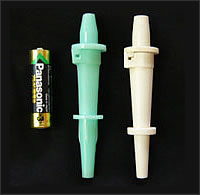
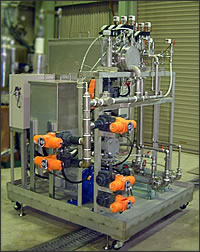
A hydrocyclone (liquid cyclone) injects treatment solution into stationary equipment to perform separation, classification, and concentration, and is an innovative separator with a very simple structure and no drive unit.
Structure of a hydrocyclone (liquid cyclone)
A suspension containing fine particles of several micrometers or more is supplied to a cylindrical container circumferentially at high speed. And as a result it starts to rotate and a centrifugal force is generated. At this time a gravitational acceleration of several tens of thousands of G is generated in the circumferential direction, and thus leading to fast sedimentation and concentration of the fine particles. The separated concentration can be freely selected by changing the supply rate (supply pressure and flow rate) and the flow ratio of the outlet. Our hydrocyclone (liquid cyclone) was designed and manufactured to classify and concentrate fine particles, and so has a small element.
THREE:
- Equipment costs can be reduced.
- Operating costs can be reduced.
- Maintenance costs can be reduced.
- Any change in raw material and product can be easily addressed.
- Large amounts can be treated in a small area.
- Separation and cleaning are easy because of the simple structure.
- Simplified control
- This equipment can be operated in synchronization with external devices.
- Alarm and interlock mechanism.
THREE:Spain and Portugal are so bound together by natural sympathy that they generally share the same vicissitudes. Bad feeling had arisen between the national party and the Government in consequence of the appointment of Prince Ferdinand, the husband of the queen, to be commander-in-chief of the army. Other causes increased the popular discontent, which was at its height when the public was electrified by the news of the Spanish Revolution. The Ministers were obliged to make concessions; but, besides being inadequate, they were too late. The steamboat from Oporto was loaded with opposition members, who were received with the most enthusiastic demonstrations of welcome. On the 9th of September the clubs had everything arranged for a revolution, and a mixed array of troops of the line, ca?adors, and National Guards, proclaimed the Constitution adopted by John VI.; and, having sung a constitutional hymn, they appointed a deputation, headed by Viscount Sa Bandiera, to wait upon Queen Donna Maria. She had first contemplated resistance, but the army would not act against the people. The National Guards were in possession of the city, having occupied the Rocio Square in Lisbon all night, and in the morning they were informed that the queen had yielded to their wishes, appointing a new Ministry, with Bandiera at its head. Some of the most obnoxious of the ex-Ministers took refuge from popular vengeance on board the ships of the British squadron lying in the Tagus. Most of the peers protested against the Revolution; but it was an accomplished fact, and they were obliged to acquiesce.
- Classification and concentration for the manufacture of inorganic powder materials
- Classification of ceramic materials
- Removal of fine particles, including iron powder
- Removal of fine particles from pigments
- Removal of fine organic particles from solvents
- Separation of starch and yeast
- Removal of fine particles from high-temperature strong acid solutions
- Removal of fine particles from low-temperature solutions